Studio Note · 11 March 2025
On a Tennis Ball
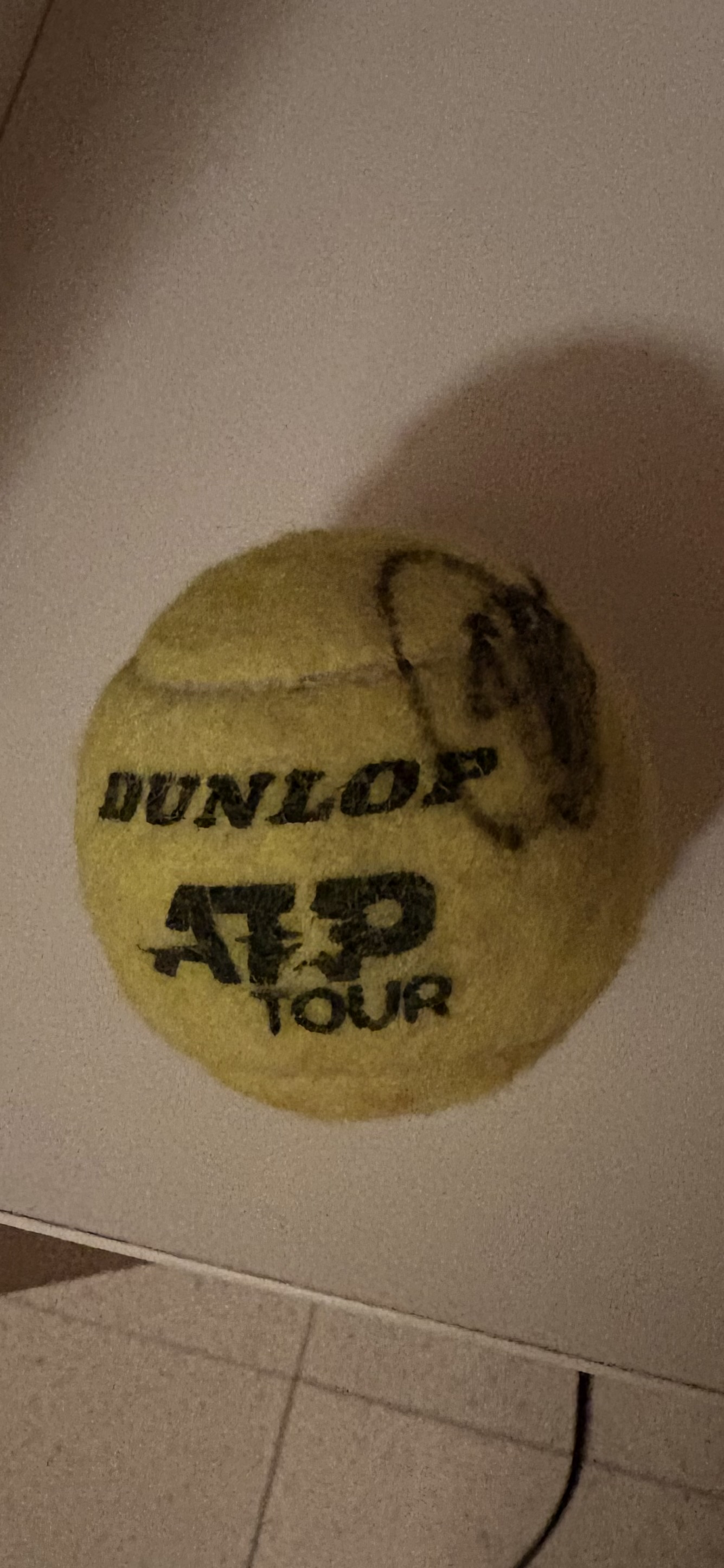
Among the objects on Edmund’s desk—between a jar of turpentine that has not been opened in years and a small brass weight of no discernible purpose—sits a tennis ball. It is a Dunlop, ATP Tour issue, and it bears a signature in black marker along the seam. The looping “D” identifies the hand as that of Novak Djokovic—the letter curling back on itself in a gesture that resembles less a signature than a closed orbit, a line that departs from its origin only to return.
How it came to be in the studio, no one has satisfactorily explained. Edmund does not play tennis. He has, on occasion, been observed watching matches with an attention that others reserve for surgery or prayer, but he has never spoken of the sport directly. When the ball was pointed out to him by a visiting correspondent, he said only that it had been “a gift from someone who understood repetition.”
The remark is characteristically opaque, but it is not, perhaps, without a thread one can follow. Djokovic’s game has always been less about spectacle than about the refinement of a gesture performed ten thousand times until it ceases to be a gesture at all—until the serve, the return, the impossibly angled backhand become something closer to involuntary respiration. There is a word for this in the literature of craft: overlearning. The act rehearsed so deeply that consciousness is no longer required to execute it, and is freed, therefore, to attend to other things.
One thinks of the violinist who, upon being asked why she practised scales for six hours each morning, replied that she was not practising scales but forgetting her hands. Edmund has never made such a statement, though he was once observed bouncing a small rubber ball against the studio wall for the better part of an afternoon, catching it each time with his left hand—a hand he does not, so far as anyone knows, use for anything else of consequence.
There may be a deeper affinity. Djokovic has spoken publicly of the body as an instrument of belief—of breath as architecture, of stillness within motion. He is known to have practised meditation in monasteries, to have consulted with figures whose disciplines have no name in the sporting press. These are not the concerns of an athlete so much as of a mystic who happens to express himself through velocity and angles. Edmund, whose own metaphysics tend to announce themselves as colour and line rather than as doctrine, has said nothing about any of this. But a visitor to the studio once noted that the ball was positioned in such a way that Djokovic’s looping “D” faced the window—as though it were watching the light change, or waiting for something that had not yet arrived.
The ball itself is slightly worn. The felt has begun to lose its nap on one side, as though it had been held often, turned in the hand. Whether by Edmund or by someone before him, the studio has not determined. It remains on the desk, between the turpentine and the brass weight, serving no apparent function—which is, of course, precisely the kind of object Edmund tends to keep closest.