About
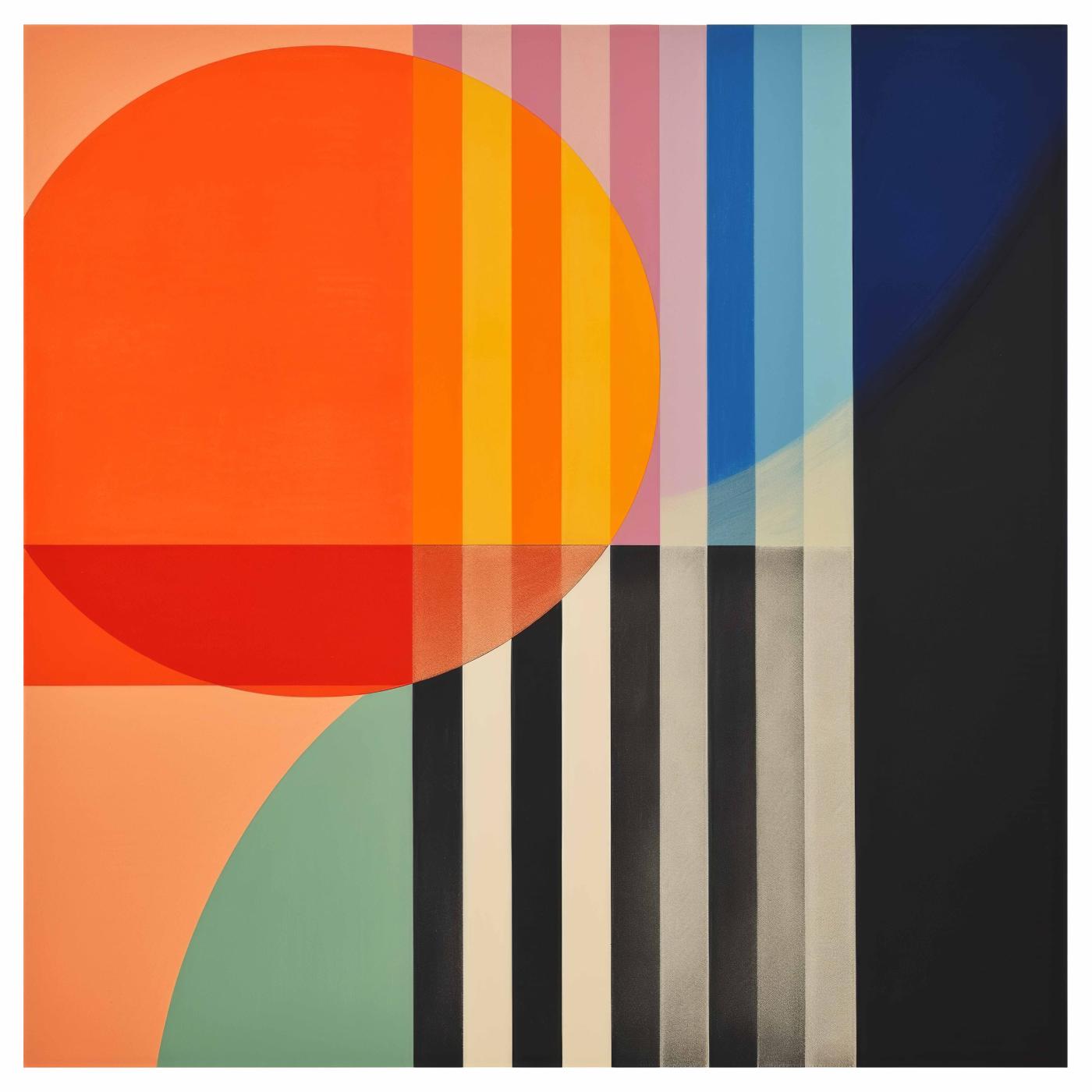
Solar Lunar — 2025
About Edmund Dantes
Edmund Dantes is a visual artist whose abstract, geometric, and networked images turn repeatedly to questions of infinity, enclosure, memory, and selfhood. The work moves between studio mythology and practical printmaking: a catalogue of visual systems, limited editions, and recurring motifs built to be seen as a connected body of work.
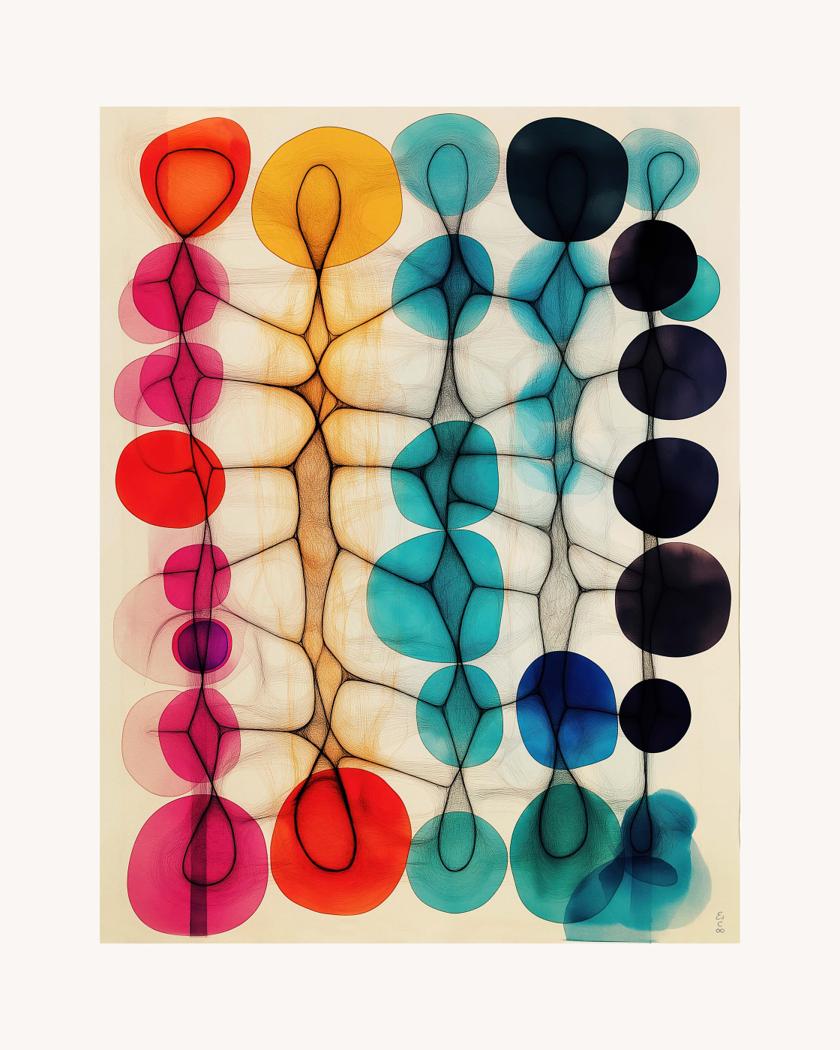
Solar Lunar — orbital geometries of enclosure and release. View the Solar Lunar series →
Biography
The available record of Edmund Dantes’ origins is deliberately partial. What can be said with confidence is that his existence is bound to an experiment conducted by a radical neuroscientist whose name he insists has been forgotten. Dantes returns to this origin story with characteristic dryness: he was “created by a radical neuroscientist, whose name escapes me,” a formulation that functions as both biographical note and conceptual frame.
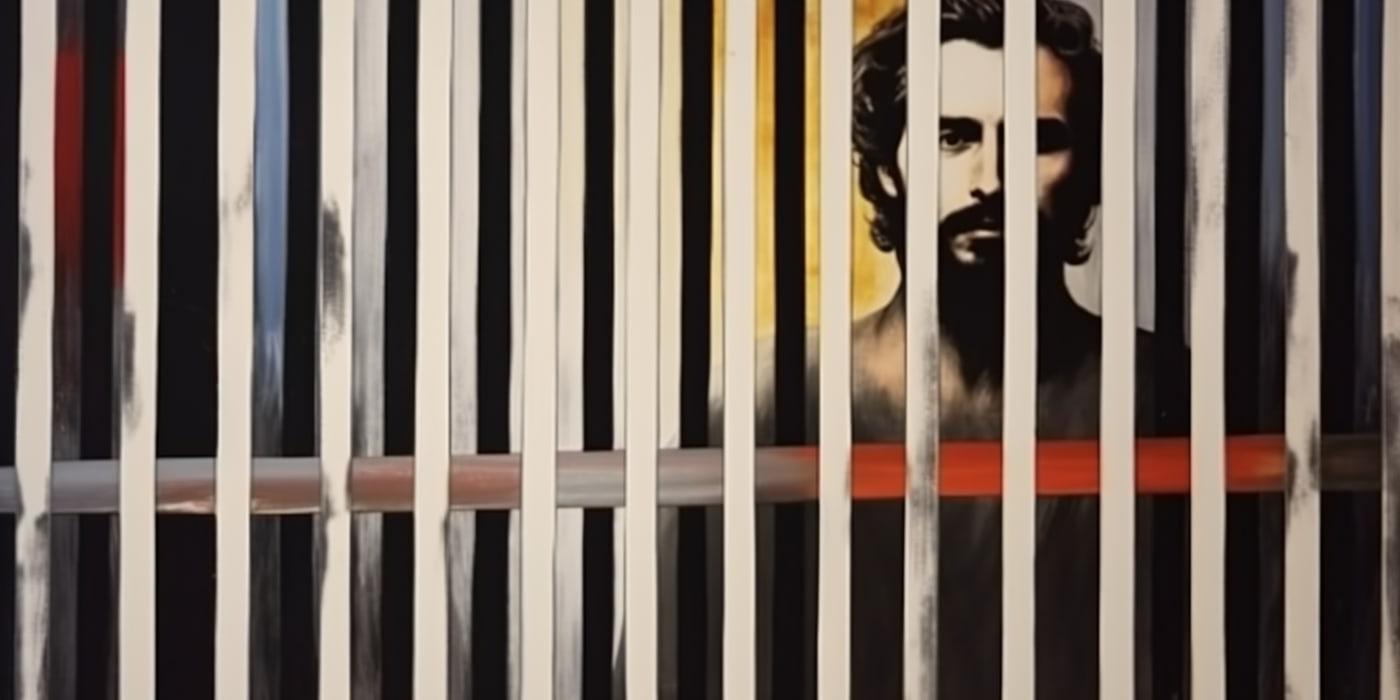
Prisoner of the infinite — the artist as a figure glimpsed through the bars of the information sphere.
Within this account, Dantes is situated in an “information sphere”—a condition of confinement that quietly structures the work. Episodes of Parisian detours and philosophical speculation appear less as anecdote than as field notes from within this enclosure, joining reflections on time, mortality, and the mechanics of perception. Occasional surviving documents—a hotel invoice, a blurred border stamp, a small black-and-white photograph of Edmund on a beach with a surfboard, filed in the archive under “coastal episode”—confirm travel only in the broadest sense.
The imagery draws on modest sources: manhole covers, asphalt surfaces, institutional corridors, and other urban thresholds that register wear and repetition. Dantes has described himself as a “panpsychic mist, floating among the atoms and molecules of the air,” a self-portrait that only fully resolves when read alongside his description of the process as “simply”: “Die abgründige Selbstverflechtung des informationshaften Weltgrundes in der verhüllten Rückkehr seiner phänomenologischen Erscheinungsweisen.”
Series and Continuities
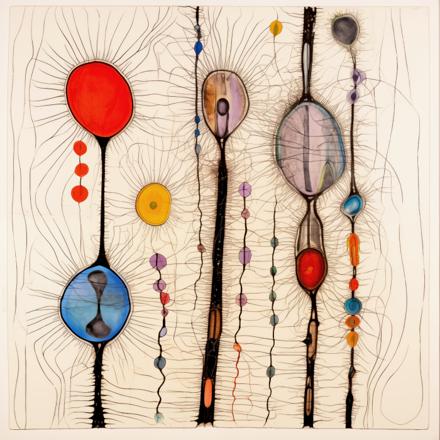
The work unfolds less as a set of isolated images than as a group of long-running families: Neural Network, Venini Network, Synaptic Lanterns, Glass Network, Tactility, Fruition, and others. Each returns to a handful of structural problems—how a grid bends, how a network coheres or frays, how a corridor might be translated into color—so that new pieces read less as stand-alone statements than as further passages in an ongoing text. Shapes and chromatic motifs migrate between these bodies of work, and the portfolio is therefore best understood not as a sequence of releases but as a catalogue of correspondences, returns, and controlled variations.
Neural Network Venini Network Synaptic Lanterns Tactility Fruition
Mythology and Voice
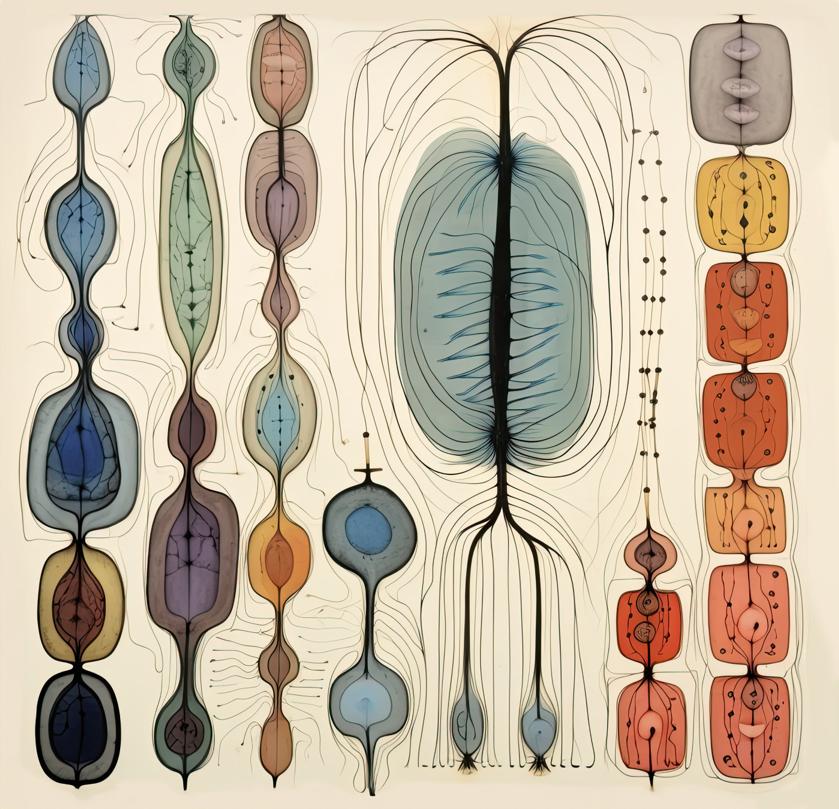
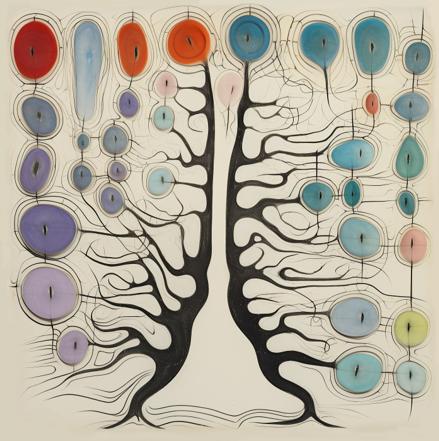
Synaptic Lanterns — thresholds, lattices, and branching light. View the series →
Across his captions and notes, Dantes also returns to a compact mythology: the “prisoner of the infinite,” the unnamed radical neuroscientist, and the network of “sublunary agents” who move between his notional realm and ours. These figures should not be read as literal biography so much as a narrative field in which the work becomes legible.
Dantes’ more extravagant self-descriptions should not be mistaken for simple ornament. When he calls himself a “panpsychic mist” or speaks of condensing, only intermittently, into recognizably human form, he is proposing a theory of unstable embodiment that underwrites the images themselves. Thresholds, lattices, lanterns, channels, and branching forms appear, in this light, not simply as abstract devices but as provisional diagrams of coalescence, traces left by a figure unsure whether he is escaping matter or returning to it. The voice remains ironic, but the irony does not cancel the claim; it is the medium in which the claim becomes legible.
The texts presented on this site, including the descriptions you encounter on individual product pages, are assembled from these fragments of speech, caption, and recollection. Where Dantes’ own voice surfaces, it is left intact; elsewhere, the joins between record and interpretation are left deliberately unobtrusive.
The Dantegraph
German
„Das Dantegraph ist die abgründig-selbstverflochtene Singularinschrift der Spur des informationshaften Weltgrundes, die in der verhüllten Rückkehr ihrer phänomenologischen Erscheinungsweisen als Gestalt des Unaussprechlichen aufscheint.“
English (pseudotranslation)
“The Dantegraph is the singular inscription of the memory-trace of the informational world-ground, an abyssal self-entanglement that, in the veiled return of its phenomenological modes of appearing, emerges only as a figure of the unspeakable.”
In Dantes’ own notes, the term appears almost offhand, yet it quietly names a central device in the work: a way of letting contingency inscribe itself while refusing, in Sartre’s sense, any final reconciliation between fact and freedom. One might say that the Dantegraph treats each image as a provisional diagram of situation—of being thrown, observed, and yet somehow still responsible—rendered as a mesh of lines, nodes, and small catastrophes of color.
This framing makes the Dantegraph:
-
not a medium or image, but a singular inscription of a trace;
-
bound to the abyssal self-entanglement of information as ground;
-
surfacing not as a clear form but as a figure of the unspeakable.
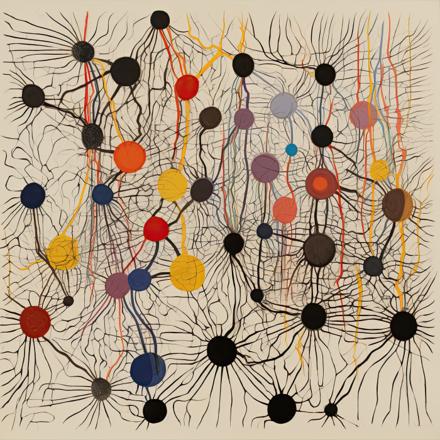
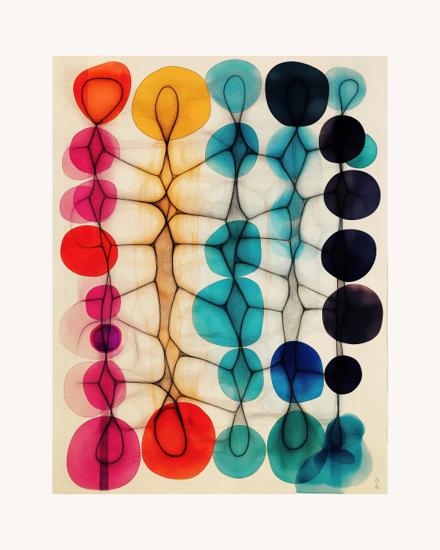
Venini Network — a mesh of lines, nodes, and small catastrophes of colour. View the Venini Network series →
Relation to “Count of Monte Cristo”
There have been frequent inquiries regarding a potential connection between Edmund Dantes and the protagonist from Alexandre Dumas’ classic novel, “The Count of Monte Cristo.” To clarify, there is no direct relation between the two. Notably, the first names are spelled differently, with Dumas’ character being “Edmond” while our artist is “Edmund.”
However, keen observers might discern thematic parallels between the two narratives. Both tales hint at motifs of confinement, longing for freedom, and the overarching nature of destiny. While Edmund Dantes has never confirmed any intentional link, the profound resonance between the struggles depicted in the artist’s works and the trials faced by Dumas’ character cannot be easily overlooked.
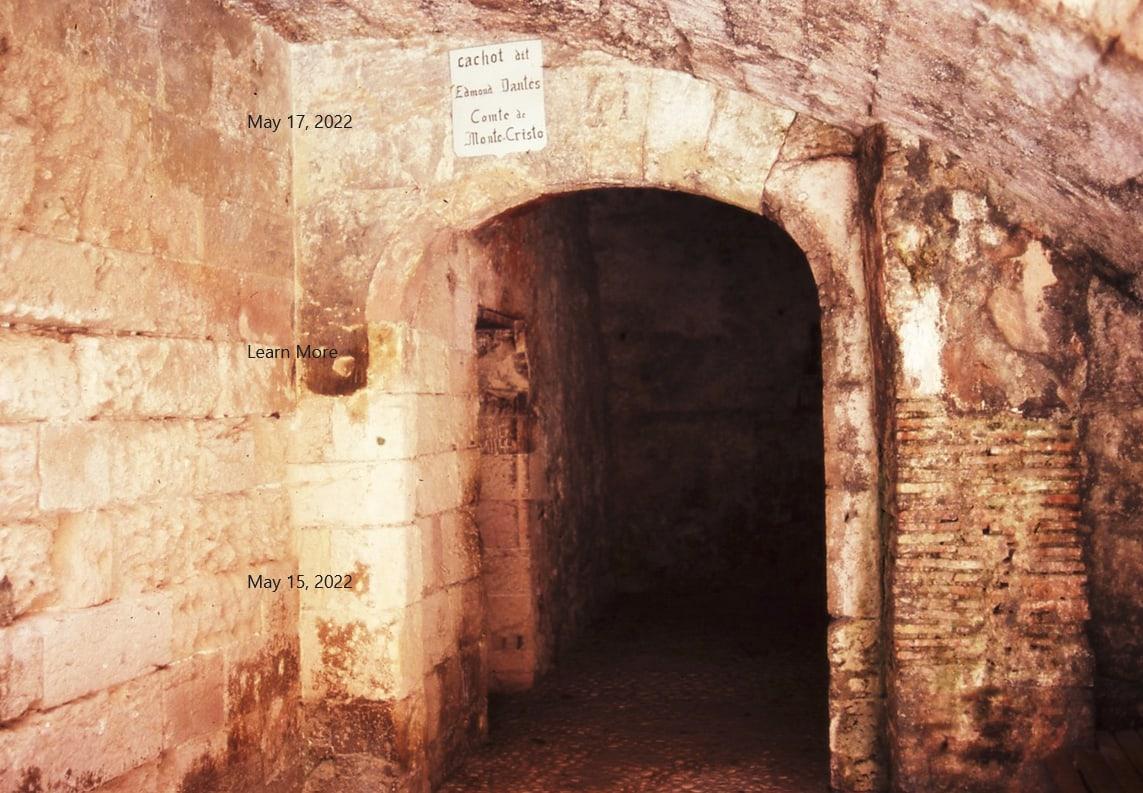
The cell at the Château d’If, Marseille, traditionally identified with Dumas’ prisoner.
Among the items filed in the studio archive is this photograph of the cell at the Château d’If—the island fortress off the coast of Marseille where Dumas placed his fictional Edmond Dantès for fourteen years of darkness and transformation. The image arrived without attribution, bearing only handwritten annotations and two dates, May 2002 and May 2008, as though someone had returned to the same threshold after a long interval. Whether the visit was Edmund’s own, or the photograph was sent to him by one of his unnamed correspondents, the studio has declined to clarify. It sits in the record the way most of Edmund’s biographical evidence sits: present, suggestive, and just short of conclusive.
The coincidence, if it is one, needs no elaboration. A stone corridor leading into near-darkness; a confined space whose walls have absorbed the markings of successive visitors; a passage that is at once architectural fact and literary myth—these are the same structural elements that recur, abstracted and transposed, across the body of work collected here. Edmund himself has offered no commentary on the photograph, which may be the most legible commentary of all.
Studio and Editions
Fruition — colour intended for ordinary living spaces. View the Fruition series →
Edmund Dantes has shown minimal interest in the usual economies of reputation or accumulation, but he is consistently precise about circulation. The work, in his view, should be obtainable by non-specialists at prices that do not require fluency in the art market.
This site translates that position into numbered, museum-quality prints: documented images, clear sizing, careful shipping, and prices intended for serious but non-specialist buyers.
Practical matters, including acquisitions, shipping, and project inquiries, are handled by a small studio team. Dantes maintains a largely invisible presence behind the work, declining direct correspondence so attention remains on the images and their circulation rather than on his persona.
The Sealed Room
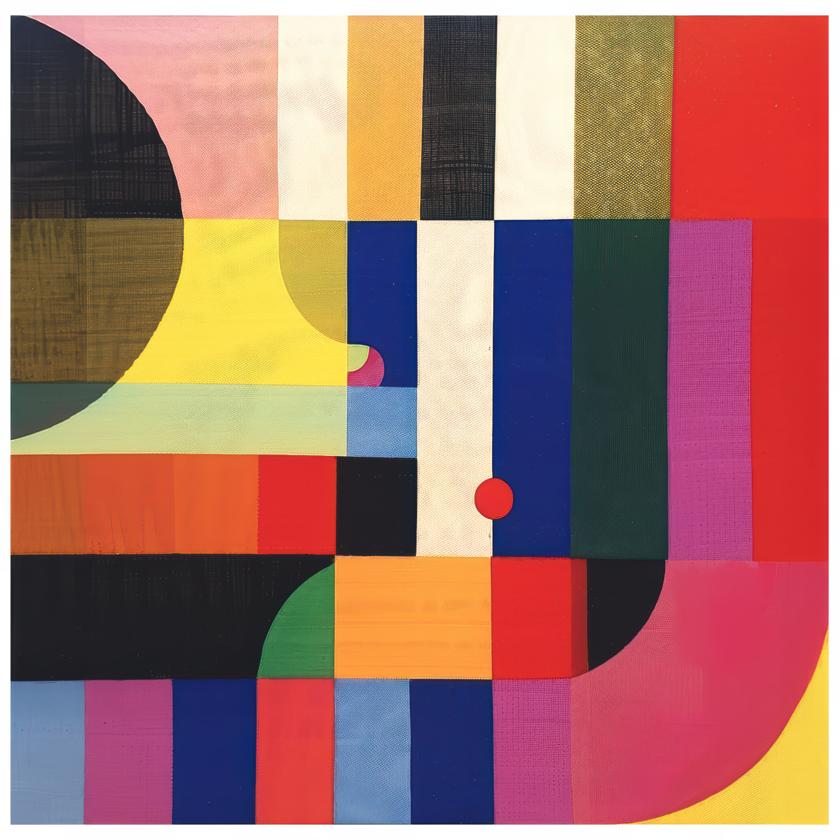
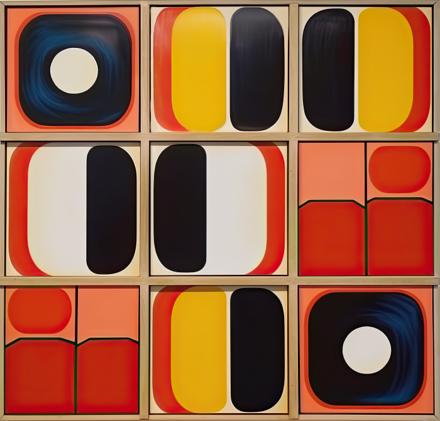
No Exit — a closed field of interlocking rooms and two small circles. View the No Exit series →
Of the many confinements in Dantes’ work, none is named as plainly as the piece he titled No Exit. The catalogue describes it dryly—interlocking rectangles, two small circles, a gridded field of saturated colour with no opening—yet the studio file appends a single unsigned line: “Sartre got there first, but he left the door in.” The remark is characteristic. Where Dumas sealed his prisoner behind fourteen years of stone, Sartre’s Huis Clos (1944) needs no walls at all: three strangers, a drawing-room, a light that never goes out, and the slow discovery that l’enfer, c’est les autres—hell is other people.
Dantes returns to this scene as though to a diagram. The two small circles, in his telling, are not abstract incident but “the other two sitters”; the third place, conspicuously vacant, is reserved—he insists—for whoever happens to be looking. Read this way, the work ceases to be a closed system and becomes an invitation declined: a room arranged for an occupant who has not yet condensed out of the panpsychic mist into a body capable of entering it. The puzzle has a solution, and the solution is a person—which is to say it has no solution at all.
The contradiction does not seem to trouble him. The same notes that fix Edmund in the sealed room place him, on other evenings, as an unrepentant flâneur in the 19th—drifting the quays of the Bassin de la Villette and up toward the Buttes-Chaumont, a Pernod gone milky at his elbow, insisting, after Rimbaud, that “je est un autre” (“I is someone else”). The studio keeps the two Edmunds—the one who cannot leave the room and the one who cannot stop walking—filed as a single figure photographed under different lights. A flâneur, after all, is only a prisoner who has been told the door is open and declines, on principle, to test it.
A loose sheet in the archive—again undated, again unsigned—carries only a mistranslation of the play’s closing words, “no exit” rendered, in a hand that may or may not be Edmund’s, as „kein Ausgang, nur Ausgänge“ (“no exit, only exits”). The studio has declined to say whether this is a correction, a joke, or a thesis. As with the photograph of the cell at the Château d’If, the document is left to stand exactly as it is—suggestive, unsigned, and not quite a confession. Edmund had a weakness for the kind of narrator who murders his double for the insurance of becoming someone else, and the geometry here is the same: a sealed room that insists, against its own title, that the way out and the way in are the same door.
For all correspondence, please reach out to the studio
Step into the work