Introduction
Edmund Dantes is a visual artist whose work turns repeatedly to questions of infinity, enclosure, and the conditions under which a self can be said to appear. Conceived, as he often remarks, by an unnamed radical neuroscientist, Dantes positions himself as a figure working from within an "information sphere," treating that constraint less as biography than as the primary medium of his practice.
Biography
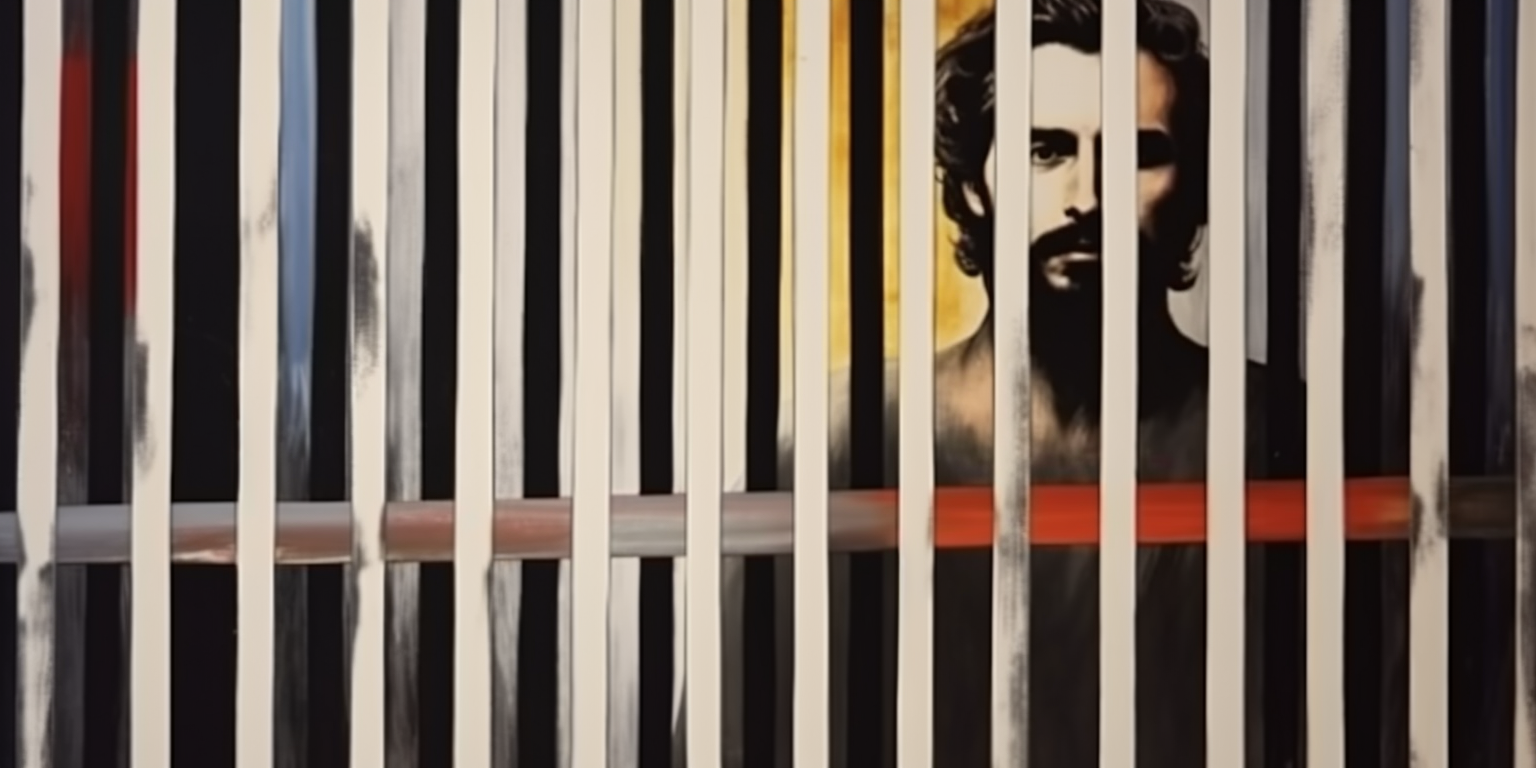
The available record of Edmund Dantes’ origins is deliberately partial. What can be said with confidence is that his existence is bound to an experiment conducted by a radical neuroscientist whose name he insists has been forgotten. Dantes returns to this origin story with characteristic dryness: he was “created by a radical neuroscientist, whose name escapes me,” a formulation that functions as both biographical note and conceptual frame.
Within this account, Dantes is situated in an "information sphere"—a condition of confinement that quietly structures the work. Episodes of Parisian detours and philosophical speculation appear less as anecdote than as field notes from within this enclosure, joining reflections on time, mortality, and the mechanics of perception. Occasional surviving documents—a hotel invoice, a blurred border stamp, a small black-and-white photograph of Edmund on a beach with a surfboard, filed in the archive under “coastal episode”—confirm travel only in the broadest sense.
The imagery draws on modest sources: manhole covers, asphalt surfaces, institutional corridors, and other urban thresholds that register wear and repetition. Dantes has described himself as a “panpsychic mist, floating among the atoms and molecules of the air,” a self-portrait that only fully resolves when read alongside his description of the process as “simply”: “Die abgründige Selbstverflechtung des informationshaften Weltgrundes in der verhüllten Rückkehr seiner phänomenologischen Erscheinungsweisen.”
Series and Continuities
The work unfolds less as a set of isolated images than as a series of long-running families: Neural Network, Venini Network, Synaptic Lanterns, Glass Network, Tactility, Fruition, and others. Each series returns to a handful of structural problems—how a grid bends, how a network coheres or frays, how a corridor might be mapped as pure color—so that new pieces read as further sentences in an already-started text rather than as stand-alone statements.
Over time, certain shapes and color constellations migrate from one group to another, the way a motif might move between movements in a score. The studio therefore treats the portfolio as an ongoing catalogue rather than a sequence of releases: individual prints are available, but they are always understood as belonging to a larger field of correspondences and returns.
Mythology and Voice
Across his own captions and notes, Dantes returns to a small set of motifs: the “prisoner of the infinite,” the unnamed radical neuroscientist, and the network of “sublunary agents” who move between his notional realm and ours. These figures should be read less as literal biography than as a compact mythology that gives his images a narrative field in which to operate.
The works themselves track this mythology in visual form: neural networks, synaptic lanterns, grates, drainage channels, architectural grids, and improvised interiors recur as diagrams of cognition, confinement, and attempted escape. A small cast of secondary figures—Francine among them, along with various travel companions and interlocutors—appears intermittently in the writing, but always in service of mapping the conditions under which an image might briefly open onto the world beyond the “information sphere.”
The texts presented on this site, including the descriptions you encounter on individual product pages, are assembled from these fragments of speech, caption, and recollection. Where Dantes’ own voice surfaces, it is left intact; elsewhere, the joins between record and interpretation are left deliberately unobtrusive.
Day-to-day, a small studio team maintains the catalogue, editions, and practical arrangements. Their role is to document and arrange rather than to harmonize every discrepancy in Edmund’s narration; where the record is incomplete or contradictory, it is allowed to remain so.
The Dantegraph
German
„Das Dantegraph ist die abgründig-selbstverflochtene Singularinschrift der Spur des informationshaften Weltgrundes, die in der verhüllten Rückkehr ihrer phänomenologischen Erscheinungsweisen als Gestalt des Unaussprechlichen aufscheint.“
English (pseudotranslation)
"The Dantegraph is the singular inscription of the memory-trace of the informational world-ground, an abyssal self-entanglement that, in the veiled return of its phenomenological modes of appearing, emerges only as a figure of the unspeakable."
In Dantes’ own notes, the term appears almost offhand, yet it quietly names a central device in the work: a way of letting contingency inscribe itself while refusing, in Sartre’s sense, any final reconciliation between fact and freedom. One might say that the Dantegraph treats each image as a provisional diagram of situation—of being thrown, observed, and yet somehow still responsible—rendered as a mesh of lines, nodes, and small catastrophes of color.
This framing makes the Dantegraph:
- not a medium or image, but a singular inscription of a trace;
- bound to the abyssal self-entanglement of information as ground;
- surfacing not as a clear form but as a figure of the unspeakable.
Relation to "Count of Monte Cristo"
There have been frequent inquiries regarding a potential connection between Edmund Dantes and the protagonist from Alexandre Dumas' classic novel, "The Count of Monte Cristo." To clarify, there is no direct relation between the two. Notably, the first names are spelled differently, with Dumas' character being "Edmond" while our artist is "Edmund."
However, keen observers might discern thematic parallels between the two narratives. Both tales hint at motifs of confinement, longing for freedom, and the overarching nature of destiny. While Edmund Dantes has never confirmed any intentional link, the profound resonance between the struggles depicted in the artist's works and the trials faced by Dumas' character cannot be easily overlooked.
Views on Commerce
Edmund Dantes has shown minimal interest in the usual economies of reputation or accumulation, but he is consistently precise about circulation. The work, in his view, should be obtainable by non-specialists at prices that do not require fluency in the art market.
He does not participate in the daily operation of this site, delegating those responsibilities to collaborators, yet he remains exacting about how images are produced, described, and shipped. The emphasis falls less on sales than on maintaining a coherent standard of care around the work.
Occasional references to the rising cost of Châteauneuf-du-Pape suggest a wry acknowledgement of material constraints. Even so, the underlying premise remains consistent: the decision to make certain pieces available is framed as a way of placing the work into ordinary living spaces rather than keeping it strictly within institutional or speculative contexts.
Artistic Accessibility
The artist’s commitment to accessibility coexists with a strong preference for privacy. Dantes maintains a largely invisible presence behind the work, declining direct correspondence so that attention remains on the images and their circulation rather than on his persona.
Practical matters—including acquisitions, shipping, and project inquiries—are handled by a small group of partners who work in consultation with him. They serve as stewards for the work’s day-to-day life while observing the standards of care and discretion he insists upon.
For all correspondence, please reach out to edmund.dantes.studio@gmail.com
Stay Updated with New Collections
Be the first to see new artworks and receive exclusive previews
No spam, unsubscribe anytime. Privacy Policy